

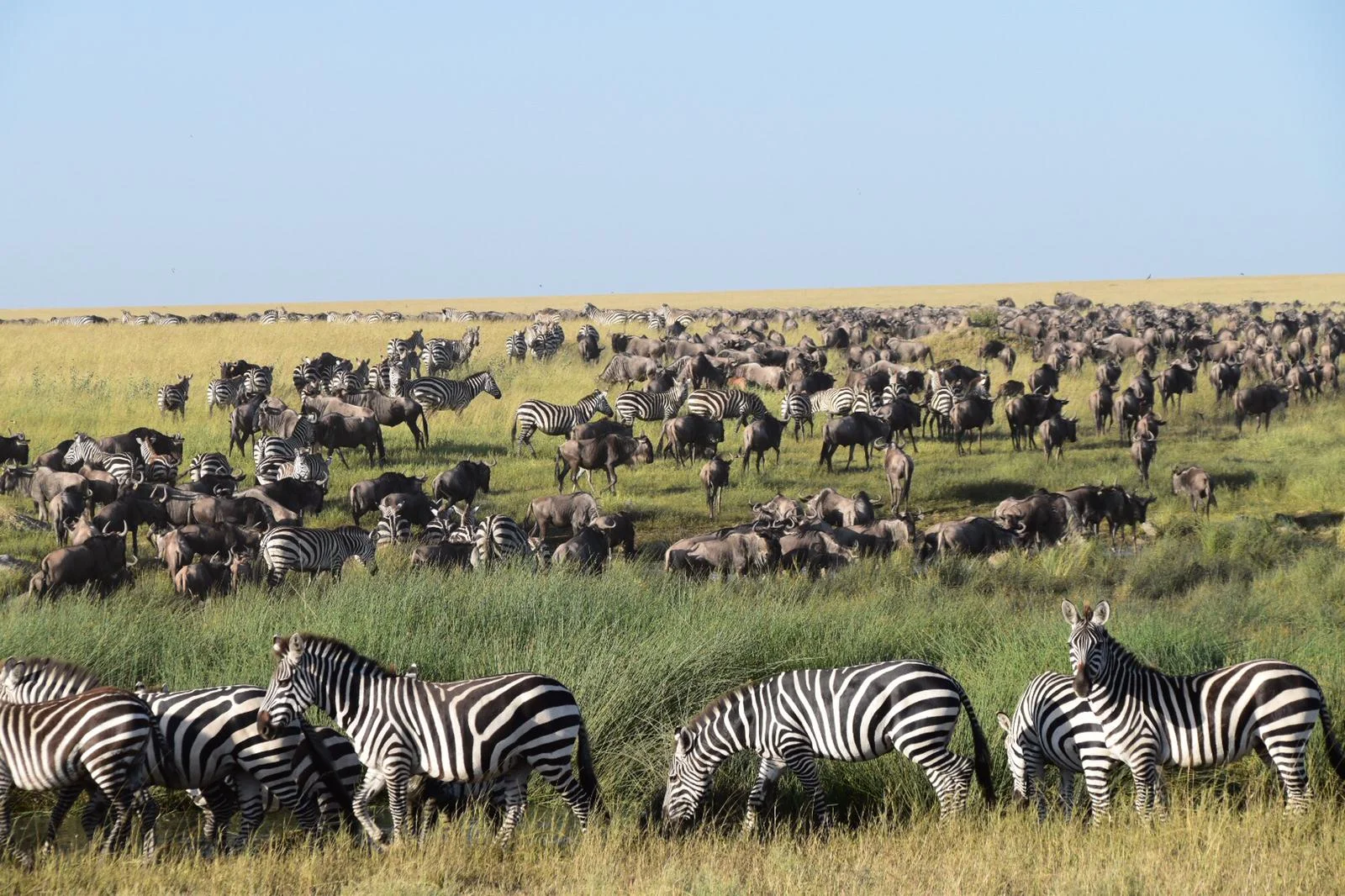
Every year, one of nature’s most extraordinary events unfolds quietly on the short-grass plains of Southern Serengeti: hundreds of thousands of wildebeest calves are born within a matter of weeks. This is the Serengeti calving season, a lesser-known but arguably more dramatic chapter of the Great Migration than the famous river crossings most travelers picture.
Unlike the crossings, which last only seconds at a time, calving season plays out slowly across weeks, offering visitors extended encounters with newborn life, protective mothers, and the predators that follow closely behind. This guide covers everything you need to know to plan your visit.
What Is the Calving Season?
The calving season is the period when the majority of the Serengeti’s wildebeest give birth, almost all within the same few weeks. In total, more than 500,000 calves are born each year, and during the peak window, an estimated 8,000 can arrive in a single day.
This synchronized birthing is a survival strategy. By producing so many calves in such a short window, the herd overwhelms predators with sheer numbers, so that any individual calf has a better statistical chance of surviving. Wildebeest give birth standing up, and within minutes their calves are on their feet, unsteady but already able to move, since they need to keep pace with the herd almost immediately to avoid becoming easy prey.
Why It’s Different from the Dry Season Crossings
Most people picture the Great Migration as chaotic river crossings, herds plunging into crocodile-filled water in a scene of struggle and panic. Calving season offers something very different.
Instead of drama at a single river, you get weeks of activity spread across wide, green plains. The landscape itself transforms, turning a dry, dusty environment into vivid emerald grassland after the short rains. It is a season defined by abundance rather than crisis, new life arriving constantly, set against some of the most photogenic scenery in the Serengeti.
When Does It Happen?
Calving season follows the rains, and generally unfolds like this:
- Late December: Herds begin moving south from the Central Serengeti as the short rains green the southern plains.
- January: Most of the herd settles into the Ndutu and Salei plains, grazing ahead of the main birthing period.
- February (Peak): The height of the calving season, when the largest numbers of calves are born. This is the best month to see a newborn taking its first steps.
- March: The grass begins to dry as the long rains approach, and the herds start drifting toward the Western Corridor.
For the best chance of witnessing the peak action, aim for late January through February.
Where It Happens
Unlike the dry season, when wildlife clusters near permanent rivers, calving season plays out on open, short-grass plains rich in calcium and phosphorus, ideal for mothers producing milk for their calves.
Ndutu, sitting on the border between the Serengeti and the Ngorongoro Conservation Area, is the heart of the action, with wide, flat terrain that makes spotting wildlife easy from a distance. The broader Southern Serengeti plains, including areas like Kusini and Matiti, offer similar conditions with tens of thousands of wildebeest spread across the horizon. For travelers wanting a quieter alternative, the areas around Olduvai Gorge and the Gol Mountains see fewer vehicles while still falling within the calving zone.
Getting There
Most travelers fly into Kilimanjaro International Airport before continuing on to the southern plains. From there, you have two main options.
A fly-in safari takes a small bush plane from Arusha directly to an airstrip near Ndutu, saving hours of driving and maximizing your time in the field. A drive-in safari is the more classic route, typically stopping at Tarangire or Lake Manyara before crossing the Ngorongoro Highlands to reach the southern plains, a scenic journey in its own right that adds extra wildlife viewing along the way.
What Else You’ll See
While the wildebeest are the main event, the plains are busy with other wildlife during this period. The open terrain makes the Southern Serengeti one of the best places in the world to spot cheetahs, which rely on speed across flat ground. Large herds of zebra move alongside the wildebeest, while giraffes, gazelles, and eland are common in the surrounding woodlands. Birdwatchers are also rewarded, with migratory species passing through and, water levels permitting, flamingos on the shallow lakes near Ndutu.
Weather and What to Pack
Calving season falls within Tanzania’s “green season,” and short, heavy afternoon showers are common, usually clearing quickly to leave clean, dust-free air behind, ideal conditions for photography. Pack a light rain jacket, waterproof protection for camera gear, and layers for cool mornings and warm afternoons. A good 4×4 vehicle is essential, since rain can make some tracks slippery.
Planning Tips
- Book 6 to 9 months in advance, since camps and lodges near Ndutu fill up quickly for peak season.
- Bring a telephoto lens if photography is a priority, the open plains reward patient, longer-range shots.
- Stay flexible with your exact dates where possible, since the timing of peak calving shifts slightly from year to year with the rains.
Experience It With Us
At Relax Africa Safari, we’ve built an itinerary specifically around this season: the 6 Day Serengeti-Ndutu Calving Season Safari, combining two full days in Ndutu with Tarangire, Ngorongoro Crater, and Lake Manyara for a complete northern Tanzania experience.
FAQs
What is the Serengeti calving season?
It’s the period, mainly January to March, when the majority of the Serengeti’s wildebeest give birth within a few short weeks, concentrated on the southern short-grass plains around Ndutu.
Is calving season better than the river crossing season?
Neither is objectively better, they’re different experiences. Calving season offers weeks of newborn wildlife and predator activity across open plains, while the crossing season (July–October) offers short, dramatic moments at the Mara River in the north.
How many wildebeest are born each day during peak season?
During the peak two-week window, usually in February, an estimated 8,000 calves can be born in a single day.
Do I need to go all the way to Ndutu to see calves?
Ndutu offers the highest concentration of activity, but calves can also be seen across the wider Southern Serengeti plains during this period.
Is calving season good for photography?
Yes. The open terrain offers clear sightlines, the post-rain light is often crisp and saturated, and the sheer volume of activity, births, nursing, and predator encounters, gives photographers constant opportunities.